Hanlu Temple · A temple you can walk into
Guandi Shrine
The first hall past the gate, and the one most often misread: in a Buddhist temple Guandi is a guardian, not a god of money — though merchants have prayed to him for centuries.
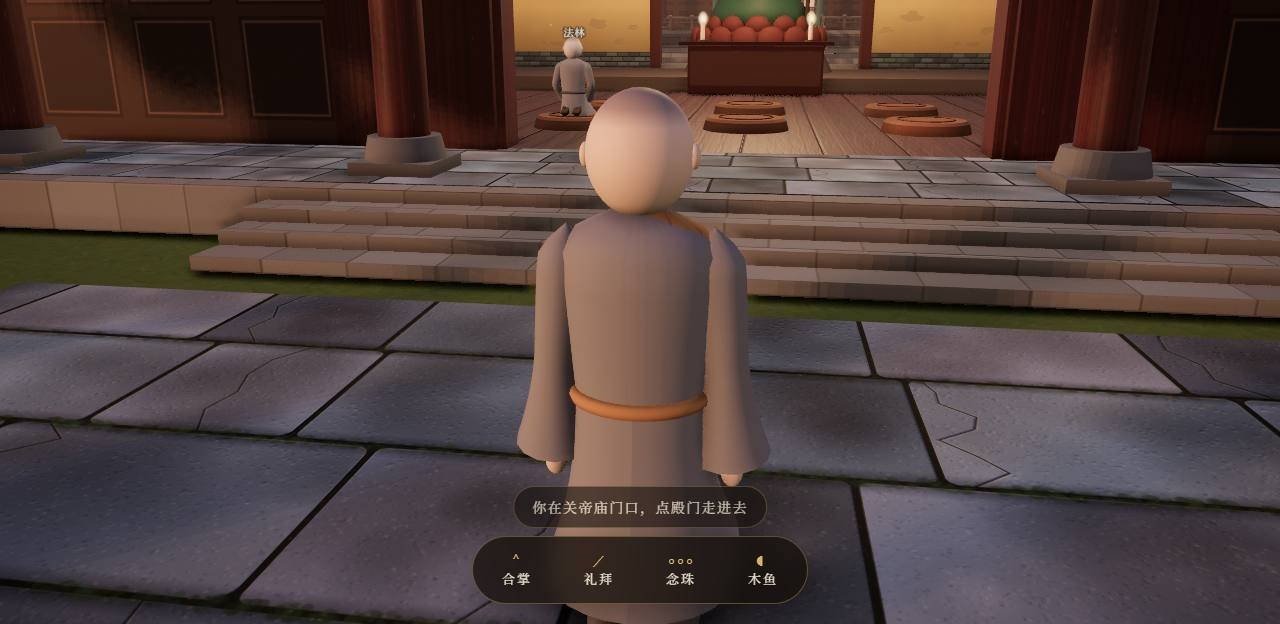
In the hall
Thirty-four metres wide, two tiers of eaves, doors front and back so you can see straight through. Inside, a green-robed, red-faced figure with a beard down to his belt and a halberd standing at his side.
Two rows of cushions. Wind comes in the south door and leaves by the north one. Sit anywhere; nobody will ask you to move.
Who is this
Guan Yu was a general of the third century, executed in 220. Over the following centuries he was promoted by emperors from marquis to king to god-emperor, and ended up as the "martial sage" standing beside Confucius, the civil one.
Merchants revere him because his reputation rests on keeping faith. That is how a soldier became a god of wealth. Buddhist temples give him a third identity, Sangharama Bodhisattva — a protector of the dharma.
In a real temple
In an actual Chinese temple he rarely has a hall of his own. He stands in the Sangharama hall, or flanks the main hall opposite Skanda. Free-standing Guandi temples belong to folk religion and Daoism, and that is where the money-god business really happens.
Couplets in his halls almost always circle one word: yi, rightness. The great temples are at Xiezhou in Shanxi, Jingzhou in Hubei and Dongshan in Fujian. One unwritten rule survives everywhere — do not promise what you cannot keep.
Written in English for readers outside China; the Chinese version is longer. All eight lots of this hall are in the lot library.